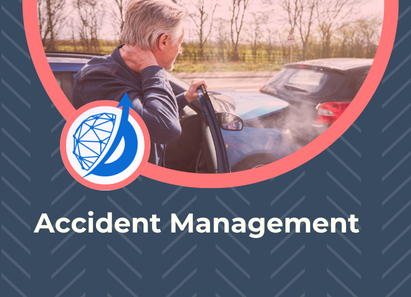
When your driver calls to say they’ve been in a wreck, your first concern is their safety. Your second concern hits almost immediately after: what happens now?
That moment — the one right after an incident — is where the gap between a well-managed fleet program and a reactive one becomes painfully obvious. If your processes are fragmented, that call kicks off a scramble. Who handles the tow? Who contacts insurance? Who documents the scene? Who gets the driver a replacement vehicle? And who’s making sure everything is being recorded properly in case of a liability dispute down the road?
For most fleet managers, accident and breakdown management is one of those areas that doesn’t get enough attention until something goes wrong. You’ve got vendors for acquisition, maintenance, and fuel — but when an incident happens, the coordination burden lands squarely on you. And if you’re already wearing too many hats, that’s a serious problem.
Here’s what a comprehensive fleet management program actually does for you in those moments.
The First 60 Minutes
Accidents and breakdowns are time-sensitive events. The decisions made in the first hour — how the scene is documented, how the driver is supported, how the vehicle is recovered — have downstream consequences that can affect insurance claims, legal liability, and total cost of the incident for months.
A fleet program built around safety and compliance gives you the protocols, technology, and support structure to respond correctly from the start. Real-time monitoring and 24/7 fleet tracking mean you often know something has happened before you get the call. When a crash triggers a sudden stop in telematic data, or when harsh braking events spike and then a vehicle goes offline, your program surfaces that information immediately. You’re not waiting on a driver to report in — you’re already aware.
That kind of visibility changes everything about how you respond.
Telematics in Accident Prevention and Recovery
Most conversations about telematics focus on the prevention side: reducing speeding, flagging harsh braking, coaching drivers toward safer habits. All of that is real and valuable. But a telematics program earns its keep in the aftermath of an incident, too.
When an accident occurs, your telematics data becomes a factual record of exactly what happened. Vehicle speed at the time of impact, GPS location, braking events in the seconds leading up to the crash — this data can be the difference between a claim being resolved quickly in your favor and a drawn-out liability dispute. With dashcam integration, you have video documentation that tells the story clearly and objectively.
This isn’t hypothetical. Fleet managers who have integrated telematics and camera systems consistently report faster claims resolution and stronger positioning in liability cases because the data removes the ambiguity. At Onward, our telematics solution through Onward Connected is designed to give you that layer of protection — AI-powered insights and data capture that don’t just optimize your fleet on a normal day but protect you when things go sideways.
Incident Reporting That Doesn’t Fall Through the Cracks
There’s a gap that catches a lot of fleets off guard: the paperwork and documentation process after an incident is just as important as the initial response, and most organizations don’t have a clean, systematic way to handle it.
Without a structured incident reporting process, you end up with information scattered across email threads, handwritten notes, and individual driver recollections. When insurance adjusters or attorneys ask for documentation months later, you’re piecing it together after the fact — and missing details are common.
A managed safety and compliance program builds incident reporting into the system. Comprehensive training modules prepare drivers to document the scene correctly in the moment: photos, witness information, police report numbers, and the information exchange process. Compliance management tools centralize that documentation so it’s accessible when you need it, not buried in a folder somewhere.
In-depth incident analysis goes beyond the individual event, too. Over time, your program identifies trends: Are certain routes generating more incidents? Are specific drivers repeatedly involved in near-miss situations? Are certain vehicle types performing differently in adverse conditions? That analysis is what allows you to shift from managing incidents reactively to preventing them proactively.
Breakdowns Are a Maintenance Story
When a vehicle goes down mid-route, the immediate priorities are getting the driver safe, arranging roadside assistance, and minimizing operational disruption. A fleet management program with national maintenance partnerships gives you access to a network of service providers who can respond quickly, at pre-negotiated rates, without you having to scramble for a shop that can take a commercial vehicle on short notice.
But the more important conversation is the one you have after: Why did this vehicle break down, and what does that tell you about your maintenance program?
Predictive maintenance technology exists specifically to catch the warning signs before they become a roadside emergency. When your program is built around proactive maintenance strategies — tracking service intervals, surfacing diagnostic alerts from telematics, flagging vehicles approaching high mileage thresholds — the number of unexpected breakdowns drops significantly. Not to zero, because mechanical failures happen. But to a level that your operation can absorb without major disruption.
Effective vehicle maintenance isn’t just about oil changes and tire rotations. It’s about having the data visibility to know which vehicles in your fleet are aging into higher-risk territory, which ones are showing performance issues that could become failures, and which maintenance investments are actually extending vehicle lifespan versus just generating service costs. That’s the difference between a maintenance program and a maintenance strategy.
Getting the Driver Back to Work
One of the underappreciated costs of an accident or breakdown isn’t just the repair bill — it’s the operational impact of a driver sitting idle while a vehicle is out of service.
A comprehensive fleet management program addresses this through vehicle lifecycle planning and, where applicable, vehicle acquisition strategies that include provisions for downtime scenarios. Understanding your fleet utilization across all assets means you can identify vehicles that can temporarily cover for one that’s out of service, rather than simply losing productivity until the repair is complete.
When a vehicle is out of service for an extended period — whether due to collision damage, a mechanical issue, or even a total loss — your program should have a clear path forward: loaner vehicle options, expedited repair tracking, insurance claim support, and if necessary, remarketing support for a totaled asset and guidance on replacement acquisition.
That last piece matters more than most fleet managers realize. After a total loss, you’re suddenly in acquisition mode at a time that wasn’t planned. A fleet program that has existing OEM relationships and understands your vehicle specifications can turn what would otherwise be months of lead time into a much faster replacement process.
The Insurance and Liability Picture
Accident costs don’t end with the repair estimate. Insurance premiums, legal exposure, and the indirect costs of a damaged safety record add up quickly — and they’re directly influenced by how well your fleet manages incident response.
Driver safety training programs reduce the frequency of incidents in the first place. That alone improves your loss history, which affects your insurance rates over time. But the claims management process also matters. Fleets that respond to incidents with complete, accurate, and timely documentation resolve claims faster and more favorably than those that are still trying to reconstruct what happened weeks after the fact.
Safety and compliance programs that include driver training, real-time monitoring, and structured incident reporting aren’t just risk management tools but insurance cost management tools. Your insurer is watching your loss run. A fleet program that demonstrably reduces incidents and handles them professionally when they do occur puts you in a much stronger negotiating position at renewal time.
Don’t Figure It Out Alone
The common thread through all of this is coordination. Accident and breakdown management touches maintenance, telematics, safety and compliance, acquisition, and program management simultaneously. When those functions operate in silos (when your telematics vendor isn’t connected to your maintenance provider, when your safety training isn’t informed by your incident data, etc.), the response is slower, less consistent, and more expensive.
A comprehensive fleet management program integrates these functions so that when something goes wrong, the response is already built into how your fleet operates. Your drivers know what to do because they’ve been trained. Your telematics data is already capturing what happened. Your maintenance partners are reachable and authorized to act. Your documentation process is systematized. And your fleet manager has a partner who’s coordinating the response alongside them, not leaving them to figure it out under pressure.
No fleet manager wants to think too hard about what happens when a vehicle goes down. But having the right program in place means that when it does happen (and it will) you’re not scrambling. You’re executing.
Ready to build the kind of fleet program that holds up when things get hard? Contact the Onward team to talk through your current accident management processes and where there might be room to improve.